
When you think of basketball, do you picture hardwood floors with paint lines, tall backboards, and (almost) equally tall players? Rarely is the gym wall padding a first thought. However, even though it is a silent hero in the game of basketball, wall padding’s importance can’t be overstated.
Basketball is an intense sport. Players fall and dive for the ball, risking their bodies for the sake of the game. Without gym wall padding, the risk of injury is significantly higher.
With players’ safety on the line, many facilities trust Polyurethane foam. This foam protects athletes, students, or community members from serious injury. It is the go-to material in wall padding.
Here’s why polyurethane foam consistently proves to be the most reliable and versatile core for wall padding across a wide range of applications.
1. Provides Consistent Impact Absorption
Whether you’re outfitting a church gymnasium, a school multipurpose room, or a behavioral health center, you want padding that responds predictably to impact. Polyurethane foam delivers this reliability.
The structure of polyurethane foam allows it to compress upon impact and gradually return to its original shape. This means when someone falls or collides with the wall, the padding absorbs and disperses the force evenly across the surface. Unlike cheaper or stiffer foams, polyurethane strikes a balance between “too soft” and “too stiff” to keep participants safe.
This makes it especially valuable in high-traffic environments, such as youth basketball gyms or facilities serving individuals with special needs, where falls and collisions are more common.
2. Supports a Wide Range of Wall Padding Applications
Polyurethane foam is versatile enough to serve nearly every need in a facility. In church activity centers, it offers protection for casual games, events and day programs. For school gyms, you can line the walls with polyurethane foam wall pads decked out in your school colors. No need to compromise school spirit with polyurethane foam.
It also adapts well to special needs settings, where safety and sensory comfort must coexist. The foam’s even density and gentle compression reduce stress on joints, minimizing the risk of bruising or discomfort during contact. These qualities are essential in calm rooms, sensory rooms, or therapeutic spaces.
3. Maintains Shape and Performance Over Time
Durability is the key to investing wisely in wall padding. Polyurethane foam passes that test time and time again. Its resistant material holds up well under repeated use, maintaining its shape and density far longer than many other foam types.
Other materials, like polyethylene or rebond foam, degrade quickly, compress unevenly, and break down under constant pressure. But polyurethane foam resists wear and tear, even in spaces where it’s put to the test daily.
The foam also resists moisture absorption, helping prevent mold and mildew buildup. That’s a major plus in facilities like gymnasiums or older church basements where temperature or humidity levels fluctuate.
4. Offers Reliable Fire Safety Compatibility
Many facilities, especially schools, public buildings, and churches, are required to meet strict fire safety standards. Class A wall padding pairs polyurethane foam with certified Class A vinyl covers to prevent fire from spreading in public spaces.
The Class A certification ensures that the padding doesn’t contribute to flame spread in the event of a fire. Polyurethane foam can meet these standards when used in combination with compliant materials, offering peace of mind to facility directors and safety officers.
5. Lightweight and Easy to Work With
Even though polyurethane foam offers serious protection, it’s relatively lightweight. That makes it easier to handle during installation, especially for full-room wall padding projects or large-scale upgrades.
The foam can be precision-cut for column padding or walls with unusual architectural features perfectly. This flexibility enables you to create custom solutions without being limited by rigid or overly bulky materials.
6. Enhances Comfort and Aesthetics
Padding does more than prevent injury. Thanks to polyurethane foam, padding makes your space more welcoming. With a smooth surface behind the vinyl covering, polyurethane padding has a polished appearance. And when wrapped in colored or custom-printed vinyl, the padding can complement your facility’s branding, team spirit, or community identity.
7. Works Well With a Variety of Vinyl Covers
Polyurethane foam is an adaptable material and can be integrated into all kinds of safety padding systems. It pairs easily with multiple types of vinyl sheeting and wraps, including antimicrobial, moisture-resistant, and fire-retardant options.
Trust Polyurethane Foam Padding
Before selecting your wall padding, take a moment to consider who uses your facility on a daily basis. Are you accommodating energetic kids in a church gymnasium? Supporting therapy and movement in a special needs classroom? Meeting fire code requirements for public events? In each scenario, polyurethane foam meets your needs.
Its balanced blend of safety, durability, and versatility makes it an ideal material for your next wall padding project.
Video

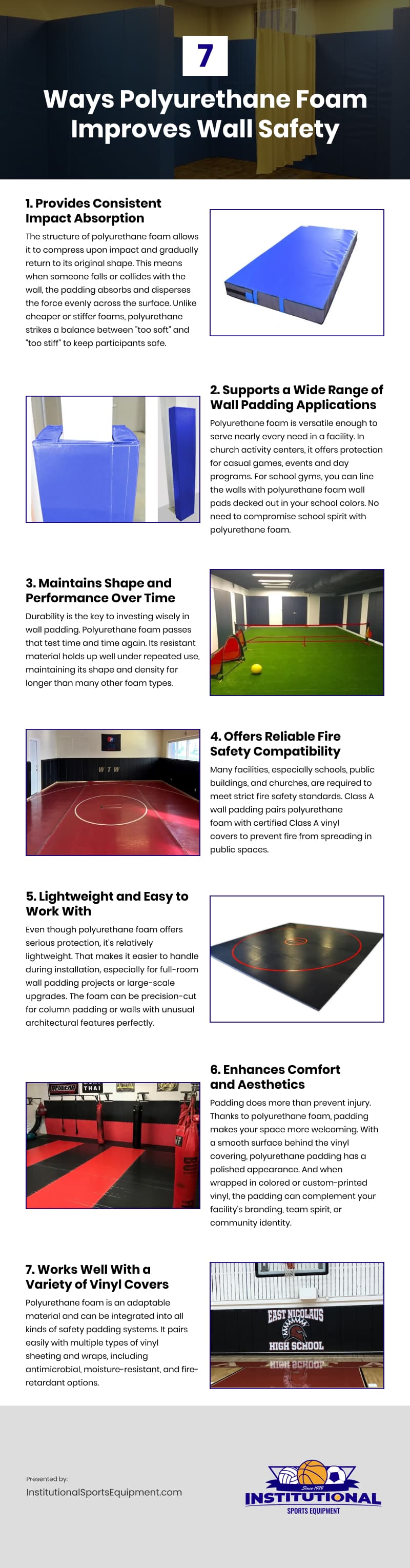
Infographic
Basketball is a high-impact sport where players often dive, fall, and collide with walls, making proper wall padding crucial for injury prevention. Polyurethane foam has emerged as a reliable core material for gym wall padding. Check out this infographic to discover how polyurethane foam enhances wall safety.