
Could you imagine a park without a basketball court? It’s like taking the ice cream out of an ice cream sandwich. Crazy, right?
Outdoor basketball courts are an incredible investment in your community. They encourage active lifestyles and support community engagement. Adult pickup games and children’s knockout games are essential parts of the community.
Now that we have established the importance of a community basketball court, ask yourself, “Do I really want to walk past a broken net, crooked backboard, and rusty metal pole every time I stroll past my park’s basketball court?” Didn’t think so. Besides the obvious eye sore an old basketball hoop can be, an outdated basketball court doesn’t provide any of the benefits of a functional basketball court.
So, before you take on the important task of upgrading your park’s basketball hoop, take a minute to learn about how to find the right outdoor basketball system for your community park.
1. Identify Your Community’s Needs
Before making any decisions, take time to understand how the basketball court is actually used. Will it serve youth programs, adult recreational leagues, or general community play? Each group brings different demands in terms of rim height, durability, and overall play intensity.
Next, evaluate how often your existing court gets used. A court that hosts frequent pickup games or city-sponsored leagues requires a system built for heavy, consistent use, which is very different from what’s needed for a quieter neighborhood park or occasional play.
2. Prioritize Durability in Outdoor Environments
Outdoor basketball systems in public settings face more wear and tear than their indoor counterparts. Exposure to UV rays, extreme temperatures, rain, and snow can take a toll on both the backboard and the support structure.
Choose a system specifically designed for outdoor installation. Look for features like:
- Powder-coated steel or galvanized frames that resist rust
- Tempered glass or steel backboards for better impact resistance
- Fixed rim systems that hold up to slam dunks and repeated use
Parks in areas with wide seasonal swings, like Chicago, Denver, or Salt Lake City, must be especially mindful of weather resistance. Paying more for high-quality material now will prevent long-term maintenance needs.
3. Consider Court Surface and Site Conditions
The court’s foundation matters just as much as the hoop itself. Make sure the court surface is level and constructed with durable and safe materials. Concrete is the most common choice for public parks because of its strength and durability. But, in a high-intensity game like basketball, where falls are bound to happen, concrete alone is a recipe for skinned elbows and bruised knees. Adding an acrylic coating or rubberized surfacing may reduce the severity of player injuries.
Make sure to think about drainage because pooling water and poor grading are a one-way ticket to an eroded foundation. Plan for proper drainage during installation to extend the life of the court and equipment.
The last item on your site condition checklist is to check for adequate space behind and around the goal for safe play. Overhead obstructions, fencing, and uneven terrain can all affect gameplay and safety.
4. Put Safety First
In a public park, you need to plan for unpredictable use. Without safety features, one wrong dive for a ball and you’re looking at a concussion, an ankle sprain, or even a broken bone. The best basketball courts prioritize safety above all.
Backboard padding protects players during rebounds or layups gone wrong. If you expect heavy use of your courts, consider padding the base of the pole or the surrounding area with safe, non-slip materials. Depending on budget, some parks opt for Class A wall padding for its safety performance.
And if you anticipate nighttime play, install lighting that evenly covers the court. Shadows and blinding glares are a recipe for disaster.
5. Choose a Vandal-Resistant System
Vandalism is a real concern in public areas. Selecting a system with tamper-proof hardware and reinforced structures helps reduce the risk of damage. Fixed basketball hoops are generally more durable than adjustable models, and steel backboards are harder to damage than acrylic or polycarbonate backboards.
Installing surveillance or positioning the court near park supervision can also deter vandalism. Local officials might also consider community outreach programs or partnerships with youth leagues to encourage respect for the space.
6. Plan for Maintenance and Longevity
Once installed, outdoor basketball systems still require upkeep. Before you buy the equipment, make sure your team or parks department has a plan for regular inspections, cleaning, and fast response if damage occurs.
You’ll want to track signs of rust, loose bolts, backboard wear, or rim issues. Even the best system can degrade if it’s not maintained correctly. Document your maintenance schedule and budget accordingly. Remember, prevention is always cheaper than full replacement.
Building a Court That Brings the Community Together
Installing an outdoor basketball system in a public park is an investment in how the community connects. A well-designed court becomes a natural meeting place for players of all ages and skill levels, encouraging physical activity, social interaction, and healthy competition. It supports a wide range of uses and helps make the space active and welcoming.
Success starts with understanding the park’s unique environment and user base, then selecting equipment that can stand up to frequent play of varying levels of intensity. Durable materials, proper placement, and quality installation all play a role in creating a court that lasts. When you address these details from the start, the result is a community asset that invites people to show up and play.
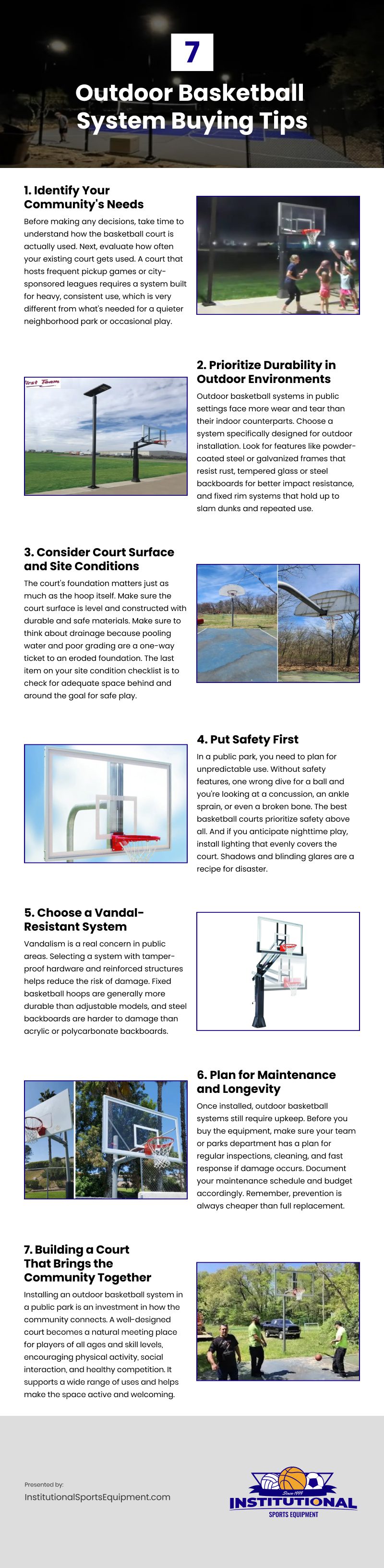
Infographic
Outdoor basketball courts energize communities, promote active lifestyles, and create shared spaces where people of all ages connect through play. Explore this infographic for tips on choosing the right outdoor basketball system.